
I used to feel every set of reverse crunches in my neck. Learning how to activate lower abs changed that in two weeks.
This guide shows the exact cues, a small home setup under $400 to $700, and the tools that let your pelvis do the work—not your chin.
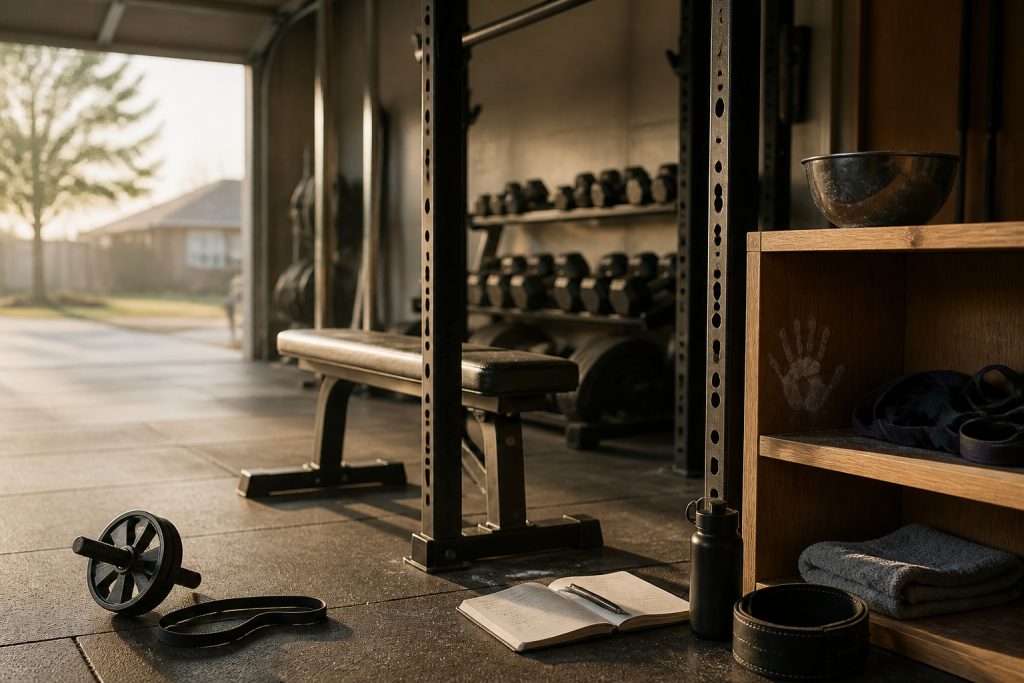
My setup is a garage-to-apartment hybrid. Minimal footprint, lots of vertical storage, and a focus on core control.
It works for lifters who want to stop neck strain during ab training. Budget: refresh under $200, full kit $400 to $700. Lately, everyone I train with adds an ab wheel and a captain’s chair.
1. Start with the Foundation: Flooring and Rack Setup

Good core work starts underfoot. Solid flooring gives you a level surface so your pelvis and spine track correctly during dead bugs and reverse crunches.
Lay down 3/8 to 1/2 inch thick rubber tiles first. They reduce bounce and keep a bench stable during seated leg raises.
I recommend a compact power rack for vertical storage and to anchor a captain’s chair later. A Foldable squat rack with pull-up bar saves space.
Leave 3 feet of clearance in front of the rack for leg-raise swings and 18 inches on the sides for kettlebell swings.
Mistake people make: thin yoga mats over concrete. They compress and cause compensatory neck tension. Use heavy-gauge tiles instead like Heavy duty rubber gym flooring tiles.
2. Layer in Free Weights and Storage

Core control drills are easier when you can load progressively. Free weights let you add anti-extension and anti-rotation resistance for lower-abs recruitment.
I keep a 7 ft Olympic barbell and a calibrated 10 kg to 45 lb plate set for landmine twists and weighted dead bugs.
For small spaces, Adjustable dumbbell pair 5 to 52 lb covers most accessory work.
Storage matters. A vertical plate tree and small dumbbell stand keep the floor clear so you can do hollow holds without tripping.
People stack plates too close to the bench. Leave 2 feet of clear walk space. Avoid cheap chrome dumbbells; go for knurled steel or neoprene for grip like the Knurled hex dumbbell set 5 to 50 lb.
3. Add Conditioning and Mobility Tools

This is where you stop lifting your neck. Tools that enforce pelvic control force the lower abs to fire.
An Ab wheel roller with steel handles teaches hollow position without neck flexion. Use a Captain's chair dip station with back pad for controlled hanging leg raises.
Add a Resistance band set with handles for resisted dead bugs and a high-density foam roller for pelvic mobility.
Key cue: posterior pelvic tilt and exhale on the hard part. That ribcage-down feel keeps the sternocleidomastoid out of the set.
Common mistake: doing ab wheel rollouts with a flexed neck. The fix is to tuck the chin and imagine sliding your ribcage toward your pelvis.
4. Finish with Lighting, Mirrors, and Atmosphere

You need to see the line from ear to hip. A mirror at knee height lets you check head position during crunches and leg lowers.
Install a full-length mirror like Wall mirror 48 by 24 inch at eye/knee level.
Lighting from above and side reduces glare so you can watch spinal alignment. A soft warm bulb strip creates a focused training vibe.
Mistake: small mirror at eye level only. You need to see pelvis movement. Mount mirror so the lower ribcage and top of hips are visible.
Common Setup Mistakes to Avoid
Mistake: Training abs on a bed or sofa
Why it doesn't work: Soft surfaces let the neck compensate and reduce lower-abs engagement.
Do this instead: Use Heavy duty rubber gym flooring tiles for a stable surface.
Mistake: Hands behind head for every crunch
Why it doesn't work: Encourages neck flexion and SCM activation.
Do this instead: Place hands lightly on chest or beside hips and use a Ab wheel roller with steel handles for core-first cueing.
Mistake: Overusing light cardio instead of pelvic control drills
Why it doesn't work: Cardio won't teach lower abs to resist lumbar extension.
Do this instead: Add controlled sets with a Resistance band set with handles.
What You'll Need for This Setup
Foundation Pieces
Heavy duty rubber gym flooring tiles around $60 to $150
Foldable squat rack with pull-up bar (price $250 to $600)
Flat bench 45 inch heavy duty approx $70 to $180
Strength & Free Weights
Adjustable dumbbell pair 5 to 52 lb around $300 to $450
Olympic barbell 7 ft 20 kg approx $120 to $300
Knurled hex dumbbell set 5 to 50 lb $200 to $500
Conditioning & Mobility
Ab wheel roller with steel handles approx $15 to $40
Captain's chair dip station with back pad $120 to $300
Resistance band set with handles $15 to $40
Finishing Touches
Wall mirror 48 by 24 inch $60 to $150
LED light strip warm white $20 to $60
Chalk bowl and block set $10 to $25
Budget Swaps
[Used adjustable dumbbells similar on Facebook Marketplace for less] (https://www.amazon.com/s?k=adjustable+dumbbell+pair+5+to+52+lb&tag=MovementClarity-100) cheaper or check local classifieds
[Secondhand flat bench, refurbished] (https://www.amazon.com/s?k=flat+bench+45+inch+heavy+duty&tag=MovementClarity-100) often under $60 locally
Shopping Guide for This Setup
Buy seasonal: Score racks and plates on Black Friday; check Foldable squat rack deals in November.
Used gear hack: Mix a new ab wheel with used plates; search local listings before buying Olympic barbell 7 ft 20 kg.
2025 trend pick: Compact multi-tools like the captain’s chair are gaining traction for core work; see Captain's chair dip station with back pad.
Splurge vs save: Splurge on a solid barbell and flooring; save on bands and the ab wheel. Resistance band set with handles approx $15 to $40.
Conclusion
Start with one cue: posterior pelvic tilt and an exhale on the effort. Add an ab wheel and resistance band for carryover. The simplest change—tucking the chin and moving the pelvis—stops neck strain fast.
If you can only buy one item, get an Ab wheel roller with steel handles.
What core cue are you going to try in your next set?

