
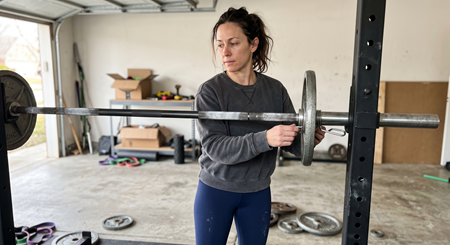
People completely lose their minds when they decide to start working out at home. They cancel their commercial gym membership and immediately try to recreate a sixty thousand dollar facility inside a two car garage. They buy cable towers with fourteen attachments, leg press machines that take up half the floor, and weird cardio gliders that end up holding winter coats by February.
I know this because I did exactly the same thing. I bought a bunch of cheap, overly complicated equipment that rattled when I used it and eventually broke.
Building a home gym should not be about recreating a commercial space. It is about distilling your training down to the absolute basics. You only need a few heavy things to pick up and a safe place to put them down. If you focus on versatile, high quality basics, you will save money, save space, and actually get stronger instead of just getting better at adjusting pins on a machine.
The Center of the Room: The Barbell
Everything in your garage should revolve around a single, high quality barbell. Do not buy the cheapest bar you can find on the internet. Cheap bars have bad knurling that tears up your hands, sleeves that do not spin, and steel that will permanently bend the first time you drop it on the safety pins.
You want a standard twenty kilogram barbell, usually called a power bar or a multi-purpose bar. You do not need a specialized weightlifting bar with needle bearings unless you are doing competitive Olympic lifts. Look for something with bronze bushings and a center knurl. The center knurl is just a rough patch in the middle of the bar that helps it stick to your shirt when you are squatting.
Keep in mind that garages are humid. If you buy a bare steel bar, it is going to rust. I spend ten minutes every month scrubbing my bare steel bar with a wire brush and oil. If you do not want to do that maintenance, spend the extra fifty dollars to get a bar with a zinc or cerakote finish. It will save you a lot of annoying cleaning time.
The Weight: Iron vs. Bumper Plates
Once you have a bar, you need something to put on it. This is where people usually make their second mistake. They assume they need thick rubber bumper plates for everything.
Bumper plates are great if you are dropping the bar from overhead. But they are incredibly thick. If you get reasonably strong, you will eventually run out of space on the bar just because the rubber takes up so much room. They are also expensive.
For most people, standard cast iron plates are the better choice. They are cheaper, they take up less space, and they make a very satisfying noise when they clink together. Just go on a local used marketplace. Iron is iron. It does not matter if it has some surface rust or chips in the paint. A forty five pound plate from twenty years ago still weighs exactly the same today. Buy a wire brush, some black spray paint, and spend a Saturday afternoon making them look new again.
Dumbbells and Space Management
You cannot do absolutely everything with a barbell. Sometimes your shoulders need a break, and dumbbells allow your arms to move in a more natural, independent path.
When I first started out, I wanted a massive rack of fixed dumbbells. I even looked for a dumbbell shop near me so I could go test the handle thickness in person. But a full set of fixed dumbbells from five to fifty pounds takes up an entire wall of a garage. It also costs a ridiculous amount of money.
Unless you have a warehouse, you need adjustable dumbbells. Yes, they are slightly bulky. Yes, it takes ten seconds to change the weight instead of just grabbing a new pair off a rack. But they replace an entire wall of equipment in the space of a small shoebox. Buy a heavy adjustable set that goes up to at least eighty pounds. You will outgrow the fifty pound sets faster than you think, especially on exercises like rows.
Do Not Ignore Your Grip
One of the biggest limiting factors for lifting heavy things is simply holding onto them. People fail deadlifts not because their back is weak, but because their hands open up.
I see people buying complicated wrist rollers and expensive forearm machines to fix this. You do not need dedicated machines for this. A simple hand grip and heavy gripper set is more than enough. I keep a set of heavy grippers sitting right on my workbench next to my chalk. I just do a few sets of holds with them while I am resting between my main exercises. It builds crushing grip strength and takes up literally zero floor space.
The Rack and the Bench
You need a power rack. Not a half rack, not independent squat stands that can tip over. You need a four post power rack that you can bolt to the floor or weigh down with plates. The rack is your spotter. If you are training alone in a garage, you need safety pins that will catch the bar if you fail a bench press or a squat. Never lift heavy without safeties.
For the bench, keep it simple. Adjustable incline benches are nice, but cheap ones wobble constantly. A heavy, flat, unadjustable utility bench is incredibly stable and usually costs half the price. You can build a very strong chest just doing flat bench presses and floor presses.
The Floor
Do not buy those interlocking foam puzzle mats meant for children’s playrooms. They will compress to nothing the first time you set a heavy weight on them, and they slide around on concrete.
Go to a farm supply store and buy three quarter inch thick rubber horse stall mats. They weigh a hundred pounds each and are virtually indestructible. They will smell strongly of rubber for the first three weeks, so leave your garage door open. But they will protect your concrete floor from cracking and they provide the perfect amount of grip for your feet.
Start with these basics. A rack, a bar, some iron, an adjustable dumbbell set, a simple gripper, and a flat bench. That is an entire lifetime of strength training sitting in a ten by ten foot square. You do not need the cable tower.